 quorum
Source available · Pico 2 · Uno R4 · Windows, macOS, Linux
Machine rules you can read, checked against every situation.
quorum turns a machine's safety rules, written in plain words, into a small program for an $11 chip. Before it goes near the machine, every combination of readings has been tried. On the chip, every answer comes with its reasons.
Free for noncommercial use. Not certified for safety-critical use.
# what the instruments report
observe vib_high          "vibration above alarm"
observe bearing_temp_high "bearing temperature high"
observe calib_overdue     "calibration past due"

# what the readings mean
claim bearing_wear "bearing degradation"
  needs vib_high bearing_temp_high

# a reason to distrust the instruments
doubt calib_stale "calibration stale"
  needs calib_overdue
  undermines vib_high bearing_temp_high

action shutdown safe when bearing_wear
validation over all 16384 states
OK no state selects two actions at once
OK every state selects an action
OK every declared action is selected in at least one state
What it does
One clear answer, and the reasons for it
Plants are full of alarms that say something is wrong and never say why, and a dead sensor reads exactly like a healthy one. quorum is built for both problems.
Rules in plain words
Readings, the conclusions they support, the excuses and doubts that can knock a conclusion down, and the actions to take. Every rule names the document it came from.
Every situation, checked
The compiler tries every combination of readings. A rulebook that gives two answers at once, or none, is refused with the exact situation that breaks it.
Runs on an $11 chip
No heap, no recursion, no floating point, and a proven bound on the worst case. The board re-checks the rulebook's fingerprint at start-up.
Answers with reasons
"Why did you stop the pump?" has a printable answer, including the readings it only assumed were absent, which matters when a sensor is dead.
Knows what happened, and when
High pressure right after a start means a closed valve; an hour later, a blockage. Rules can say "within 10 s after" or "3 times in an hour", and every situation is still checked.
AI drafts, a person approves
A model drafts a rulebook from an equipment manual, quoting it word for word. Nothing reaches a chip until a named person approves it.
How it works
From a document to a board, in four steps
The same tools run in the desktop app and in the test suite, so a rulebook the app accepts is one the tested toolchain accepted.
Write
Write the rules, import a worksheet, or have an AI draft them from the manual.
Check
The compiler solves every situation and refuses a rulebook with any gap.
Load
Write the small image to a Pico 2 or Uno R4. The firmware never changes.
Commission
Print the loop-check sheet and work through it on the real machine.
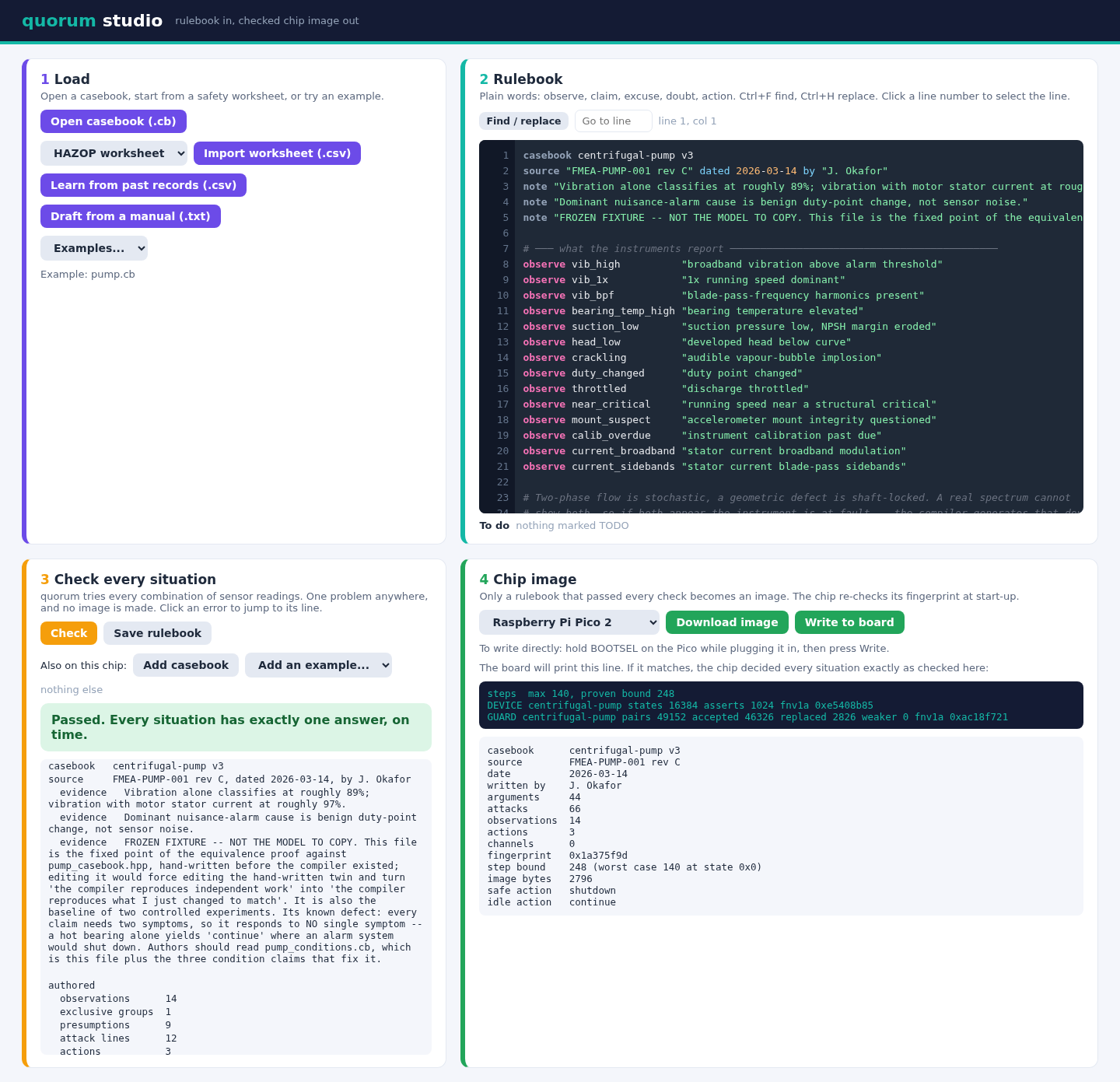
quorum studio
One app, entirely on your computer
Open or draft a rulebook, check every situation, write the chip image and print the commissioning sheet, for Windows, macOS and Linux, with no compiler to install.
- A refused rulebook shows the situation that breaks it, and often a one-click repair
- "Test the board" drives a connected board over Modbus through every line of the sheet
- Hosted AI models are used only through providers that keep no copy of your manual
Guides
Machine safety rules, explained
Each guide starts from nothing: what the thing is, why it matters, and how quorum handles it.
 Basics
Interlocks explained: the rules that stop a machine before it hurts itself
What an interlock is, the idea of a safe action, alarms versus shutdowns, and how quorum writes a rule a person can read and check.
Read the guide → Sensors
A dead sensor reads like a quiet one: how to write rules that notice
A failed sensor reads just like a quiet one. How quorum writes rules that notice the difference, and shows the assumptions behind every answer.
Read the guide → Voting
2-out-of-3 voting: why plants use three sensors, and what goes wrong when one lies
Why plants use three sensors and trip on two, what a spurious trip and a missed trip are, and how a voted function can quietly collapse to a single sensor.
Read the guide → The full check
Why a safety rulebook should be checked against every situation, not tested on a few
Testing a few scenarios cannot cover a safety rulebook. quorum checks every combination of readings before the rules go near a machine.
Read the guide → Alarms
Nuisance alarms: why operators stop listening, and how excuses in the rules help
Too many false alarms and operators stop listening. Benign explanations written into the rules keep an alarm quiet until it matters.
Read the guide → Worksheets
From HAZOP, LOPA and FMEA worksheets to rules a machine can run
quorum imports HAZOP, LOPA and FMEA worksheets into a draft rulebook, flags the gaps, and refuses it until an engineer finishes it.
Read the guide →Said plainly
What quorum has not done yet
No plant runs quorum. Both example rulebooks were written by its own developers, it is not certified for any safety standard, and the strongest missing evidence is an engineer outside BioDream writing a rulebook from their own worksheet. Every claim on this site links to the test behind it, and the honest limits are listed in full.